6-Week GD-PI Prep for Working Professionals: The 3-Track System for IIM Lucknow, FMS and Other B-School Calls
TL;DR
Ace your MBA interviews with a 6-week GD-PI prep for working professionals. Learn to balance GD drills, PI stories, and current affairs in 9 hours a week.
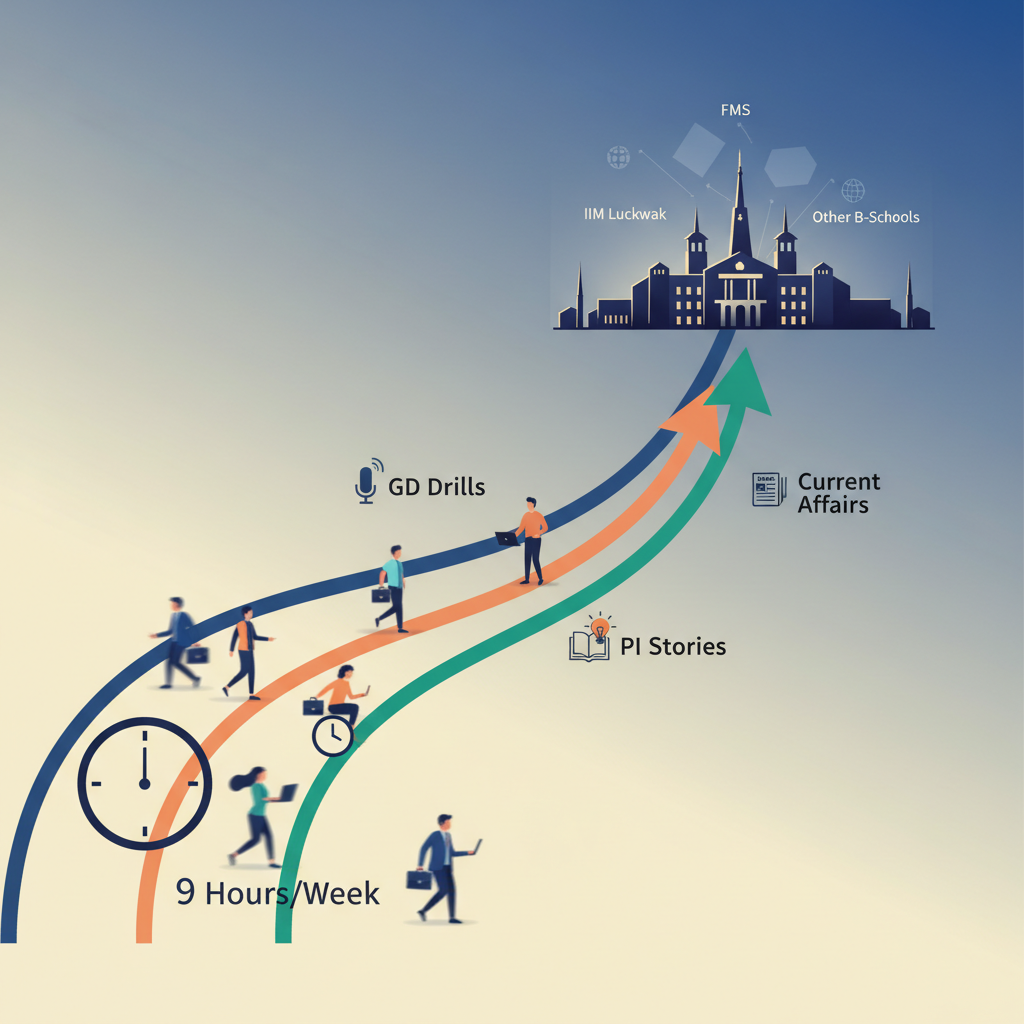
Got IIM Lucknow and FMS calls, GD skills rusty, and a full-time job eating your weekdays? A structured 6-week GD-PI prep for working professionals is your fastest fix, built on a parallel 3-track system: run GD fluency drills, PI storytelling work, and current affairs triage every week instead of doing them one after another. Roughly 3 hours a week on GD, 4 on PI, and 2 on current affairs, weighted heavily toward weekends, gets a rusty candidate to "decent and coherent" by interview day.
Most GD-PI guides written for full-time students assume you have three uninterrupted hours a day. Working professionals don't. Almost every guide out there, including the widely shared IIM Lucknow student's D-Day breakdown, has a major gap. They show you what good GD structure looks like. However, they never show how to fit practice into a busy schedule. You might be commuting, sitting in meetings, or simply exhausted by 9pm. This piece gives you the hour allocation, the weekly rhythm, and the weekend-only sequencing. Your job won't let you skip these.
Why Working Professionals Need a Different GD-PI Timeline
If you're prepping around a job, the constraint isn't knowledge, it's contact hours. You can read every current affairs roundup on the internet. However, you only improve GD fluency and PI storytelling through repeated, spaced practice. A 9-to-6 schedule squeezes that practice out first.
This matters because of where the marks actually sit. According to a breakdown of IIM Bangalore's admission criteria, the personal interview alone often carries 40% of the final selection weight. WAT adds another 10% across IIMs.
According to a timeline of the IIM admission cycle, CAT results land in December. Most IIMs run GD and PI rounds from February through April. This schedule means a six-week runway is not unusual. It is the norm for anyone who received calls in the second or third list. A working professional doesn't get more time than a full-time student for this stage. The system has to make up for it in structure, not hours.
The 3-Track System: Hour Allocation for a 6-Week Weekend-Heavy Schedule
The core idea is simple: never let GD, PI, and current affairs become sequential "phases." Run each track every single week at a different intensity. This ensures your fluency, your stories, and your knowledge base all mature at the same pace. No single track will lag behind the others going into week 6.
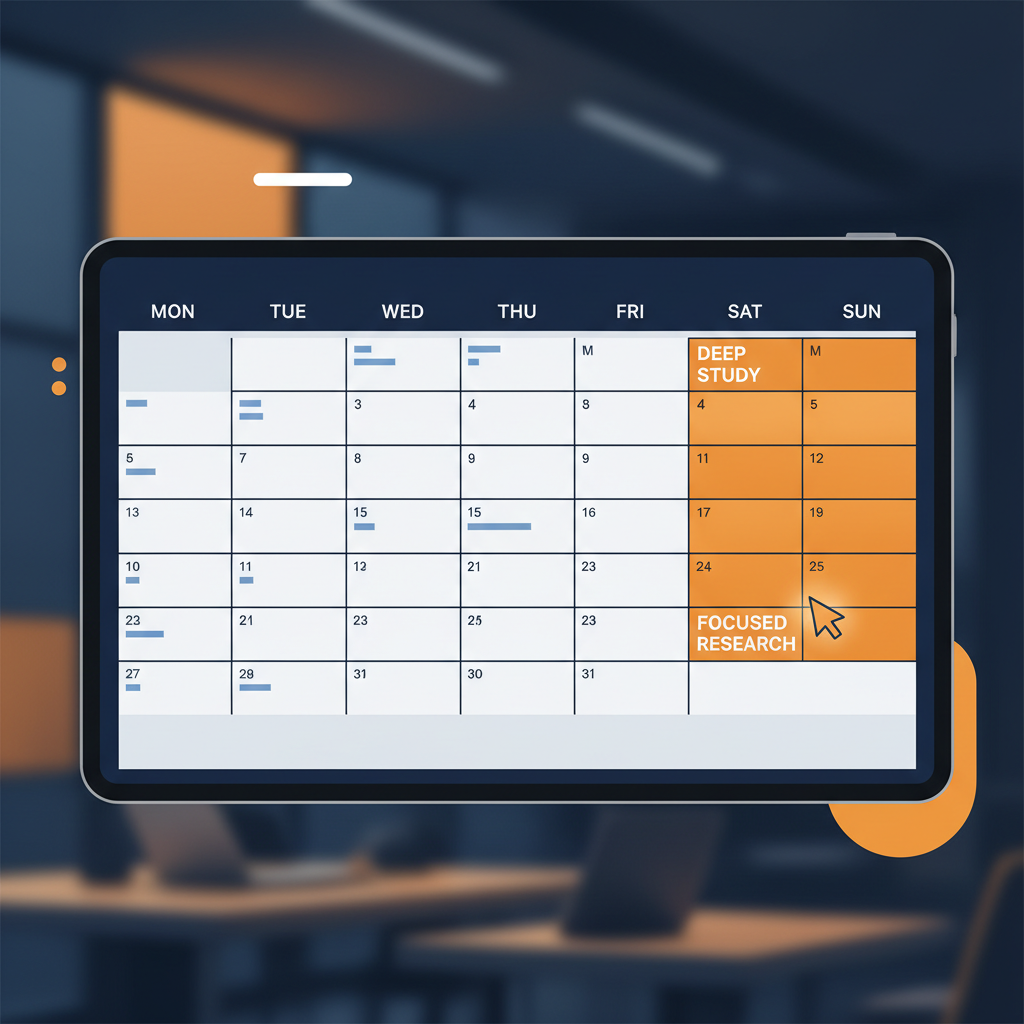
Here's the weekly split that fits around a job:
| Track | Hours/week | When it happens |
|---|---|---|
| Track 1: GD Fluency Drills | 3 hours | 2 weekday evenings (30-45 min solo drills) + 1 weekend block (live practice) |
| Track 2: PI Storytelling | 4 hours | Concentrated across Saturday and Sunday, since this needs writing and rehearsal, not just reading |
| Track 3: Current Affairs Triage | 2 hours | 15-20 minutes daily, Mon-Fri, plus a 30-45 minute weekend consolidation |
That's roughly 9 hours a week, 54 hours across six weeks. You can move from "terrible" to genuinely competent. Just spend the hours drilling and rehearsing, not just reading advice articles.
Track 1: GD Fluency Drills
GD is a performance skill, not a knowledge skill. That is why passive prep (reading GD tips) barely moves the needle. We built this track around short, high-frequency reps. You will structure a point fast, enter a discussion without hesitation, and disagree without derailing the group.

Split your GD prep across three topic categories so you're never blindsided:
- Current affairs and policy topics: things like economic reforms, tech regulation, or social policy debates that show up because they're in the news that month.
- Abstract and opinion topics: statements like "GDs are a poor way to judge candidates." You need a framework more than facts to answer these.
- Business and case-flavored topics: light business scenarios where a structured take (market, stakeholders, trade-off) beats raw opinion.
For structure, the IIM Lucknow student's GD framework still holds up well. First, clarify the topic's terminology. Then, break it into two or three sub-headers before anyone else does.
If the topic is unfamiliar, hold back. Listen for two or three exchanges. Enter with a genuinely new angle rather than repeating previous points.
A breakdown of IIM GD-PI-WAT rounds recommends a similar structuring method, the PEEL approach (Point, Evidence, Explanation, Link). This works well as a default template when you lack a sharper one.
The practice protocol for weekday evenings: pick one topic. Give yourself 60 seconds to frame an opening statement out loud. Record it on your phone, then listen back and cut every filler word. On weekends, get into a real group. Even four or five people over a video call count. Aim to speak with something substantial at least three times per discussion. InsideIIM's GD-WAT-PI prep guide echoes this benchmark. Visibility without content is noise; people ignore content without visibility. You need both.
Track 2: PI Storytelling Frameworks
The personal interview rewards a clear, rehearsed narrative far more than it rewards raw achievement. Panels have already read your resume. They are testing whether you can explain your own decisions coherently under mild pressure. This is exactly where working professionals with strong profiles but weak articulation lose marks.
Two frameworks deserve almost all of your Track 2 hours: your SOP-style personal narrative and your "Why MBA" answer.
Break your personal narrative into a five-beat structure. Include your background, your career-shaping decision point, your actions, your learnings, and your next steps. Write this out once, fully, in week 1. After that, only rehearse it. Never rewrite it from scratch. Constant rewriting makes your answers sound stitched together instead of natural.
Your "Why MBA" answer needs its own architecture. You must show the specific gap in your current role or trajectory. Explain why an MBA closes that gap, rather than a certification or lateral move. Finally, show why this particular institute fits that plan better than your alternative option. An experienced panel dismantles vague answers here ("I want to grow my career") in seconds. If you want a further breakdown of the exact architecture, this Why MBA answer framework walks through how to build one that survives follow-up questions.
The biggest failure mode at this stage isn't a bad story, it's a good story delivered like a memorized script. Working professionals who've rehearsed answers in isolation, without a listener, tend to sound stilted by the time interviews actually happen. If your mock answers keep coming out flat or robotic, this guide on fixing PI answers that sound rehearsed is worth running through before your first real mock, since it deals with exactly that gap between "well-prepared" and "sounds natural."
Spend your weekend PI hours in this order: 45 minutes writing or refining a story, 45 minutes saying it out loud unscripted, then a full mock PI session (even 20 minutes with a friend playing panelist) where you're forced to handle follow-ups you didn't prep for.
Track 3: Current Affairs Triage
Current affairs prep for GD and WAT doesn't reward volume, it rewards triage: knowing enough about the right ten to fifteen topics to hold a structured point, rather than skimming forty topics you can't speak to for more than one sentence.
Panels and GD topics broadly test four areas: current affairs, case-based topics, your CV or resume, and behavioral or situational judgment, according to an IIM Lucknow student's decoding of the selection process. Given six weeks and a day job, current affairs is the one area where "triage" beats "coverage." Spend your daily 15-20 minutes on one national newspaper's opinion or editorial section, not the full paper, and actively note the two or three arguments on either side of each issue rather than just the headline.
On weekends, consolidate: pick the three or four topics that appeared most often that week and write a five-line structured take on each, covering both sides of the argument. This doubles as WAT prep, since the WAT round typically runs 15-30 minutes for a 200-400 word essay, per a rundown of the WAT-PI round, and rewards the same "state both sides, then take a structured position" habit you're building for GD.
Keep a running one-page list of topics with your one-line stance on each. By week 5, this becomes your revision sheet, not a new reading list.
The Week-by-Week Schedule
Six weeks isn't enough time to "study everything and then perform." It's enough time to build fluency in three tight loops if you sequence the phases correctly: foundation first, then volume, then integration, then a genuine taper before D-Day.
Here's how the six weeks should actually break down given the parallel-track structure above.
- Weeks 1-2, Foundation: Write your PI narrative and Why MBA answer fully once. Build your current affairs topic list from scratch. Do two solo GD drills per week; don't worry about group practice yet.
- Weeks 3-4, Volume: Add live GD practice with a group every weekend. Start full mock PIs, one per weekend minimum. Current affairs shifts to daily triage plus weekend consolidation.
- Week 5, Integration: Run a full mock GD-WAT-PI sequence in one sitting, mimicking the actual day's order. This is where most candidates discover their PI story doesn't hold up after a tiring GD, which is exactly the failure mode you want to catch a week early, not on the actual day.
- Week 6, Taper: No new topics. Revise your current affairs sheet, do two light mock PIs early in the week, then rest. A calm, well-slept candidate consistently outperforms an over-drilled, exhausted one, a point the IIM Lucknow student's D-Day advice makes explicitly about the night before.
FAQs on 6-week GD-PI prep for working professionals
Can I compress this 3-track system into 4 weeks? Yes, but drop the foundation phase to one week and go straight into volume, since working professionals lose the most from skipping live GD practice, not from skipping reading time. Expect noticeably less polish on your PI storytelling, since rehearsal quality tracks with repetitions, and four weeks gives you roughly a third fewer of them.
How many hours a week should a working professional realistically commit? Around 9 hours a week split across the three tracks (3 for GD, 4 for PI, 2 for current affairs) is workable alongside a full-time job if weekends carry most of the load. Going meaningfully below that usually means one track, almost always current affairs, gets neglected entirely.
Is GD or PI more important to prioritize if I'm short on time? PI, since it typically carries the largest share of final selection weight across IIMs, often around 40% based on published IIM Bangalore selection weightage. GD still matters for shortlisting at institutes that use it, but a strong, natural-sounding PI recovers more marks than a strong GD alone.
Do I need a practice group for GD, or can I prepare solo? Solo drills fix structure and filler words, but they cannot fix your read on group dynamics, timing your entry, or reacting to being interrupted. You need at least weekly live practice, even informally with two or three peers, to build real GD fluency.
What if my current affairs knowledge is genuinely weak going in? Triage hard. Fifteen well-understood topics with a structured, two-sided take beat forty half-remembered headlines. Spend week 1 building the list and don't expand it after week 3; use the remaining time to deepen, not widen.
Crack Your GD-PI Round with Rodha
Six weeks is tight, but it's enough time if your prep has structure instead of scattered advice. Rodha's MBA interview prep is built around exactly this problem: parallel-track practice for working professionals who need their GD fluency, PI storytelling, and current affairs sharp at the same time, not in sequence. Check the pricing page to see which track fits your six weeks.